
Lazy Eye (Amblyopia): Why Early Detection Can Save Your Child’s Sight
As parents, we track every milestone—first steps, first words, first teeth. But there is one critical area of development that often flies under the radar until a problem arises: vision.
One of the most common, yet easily missed, childhood vision issues is amblyopia, widely known as “lazy eye.” Affecting roughly 2 to 3 out of every 100 children, amblyopia isn’t just about an eye that wanders; it’s a neurological condition where the brain and the eye fail to work together properly.
The good news? It is highly treatable. The catch? Early detection is everything.
Here is everything you need to know about spotting, understanding, and treating a lazy eye before it permanently impacts your child’s vision.
What Exactly is a “Lazy Eye”?
Despite the nickname, the eye itself isn’t actually “lazy.” Amblyopia occurs when the neural pathways between the brain and one of the eyes don’t develop properly during early childhood.
Because one eye is sending a blurry or incorrect image, the brain eventually starts to ignore the signals from that weaker eye, relying entirely on the stronger one. Over time, if left untreated, the vision in the weaker eye can permanently decline.
The Three Main Causes of Amblyopia
Amblyopia doesn’t happen out of nowhere. It is almost always a secondary effect triggered by another underlying vision problem:
- Strabismic Amblyopia (Muscle Imbalance): This is the most common cause. If a child has crossed eyes or an eye that wanders outward (strabismus), the brain receives two different, conflicting images. To avoid double vision, the brain simply “turns off” the input from the misaligned eye.
- Refractive Amblyopia (Unequal Focus): This happens when one eye has a significantly different prescription than the other (e.g., one eye is very nearsighted, or has heavy astigmatism, while the other is normal). Because the eyes look perfectly aligned from the outside, this type is incredibly difficult for parents to spot without a professional eye exam.
- Deprivation Amblyopia: This is the most severe and rare form. It occurs when something physically blocks light from entering a baby’s eye, such as a congenital cataract or a drooping eyelid. This requires immediate medical intervention to prevent permanent blindness in that eye.
The Hidden Threat: Signs and Symptoms
The trickiest part about refractive amblyopia is that there are often no obvious symptoms. Because the stronger eye takes over and does all the heavy lifting, the child rarely realizes they have a bad eye, and their eyes may look completely normal to you.
However, keep an eye out for these subtle red flags:
- Squinting or shutting one eye, especially in bright sunlight.
- Frequent head tilting (the child is subconsciously trying to use their “good” eye).
- Poor depth perception (clumsiness, trouble catching a ball, or difficulty navigating stairs).
- An eye that occasionally wanders inward or outward, especially when the child is tired or sick.
- Complaints of headaches or eye strain.
Why Early Detection is the Ultimate Cure
The visual system in the brain is highly adaptable (plastic) during the first few years of life. This plasticity peaks around age 7 or 8.
If amblyopia is caught during this “critical window,” treatment is highly successful, and normal vision can often be fully restored. The brain is essentially retrained to accept signals from the weaker eye.
If a lazy eye is left undiscovered until the pre-teen or teenage years, the brain’s visual pathways are mostly hardwired. While newer treatments are showing promise for older patients, it is significantly harder to restore vision once that critical window has closed. Untreated amblyopia is actually the leading cause of monocular (single-eye) vision loss in adults.
How is Lazy Eye Treated?
Treatment for amblyopia is twofold: first, fix the underlying problem, and second, force the brain to use the weaker eye.
1. Corrective Glasses
If the root cause is a refractive error (like unequal prescriptions), prescription glasses are the first line of defense. For some children, simply wearing the right glasses is enough to correct the amblyopia over time.
2. Patching (Occlusion Therapy)
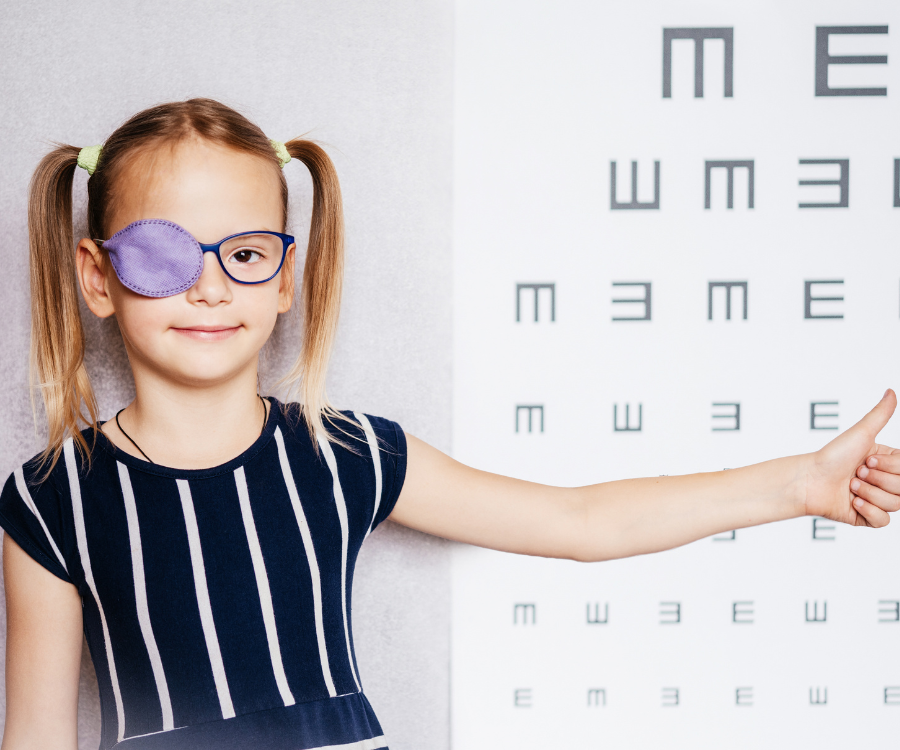
This is the gold standard for treating a lazy eye. An adhesive patch is placed over the stronger eye for a few hours a day. This forces the brain to wake up and start communicating with the weaker eye, strengthening the neural pathways.
3. Atropine Eye Drops
If a child absolutely refuses to wear a patch, pediatric eye doctors can use special blurring drops (Atropine) in the stronger eye. Much like the patch, this temporarily blurs the good eye, forcing the brain to rely on the lazy eye.
4. Surgery
In cases of severe strabismus (crossed eyes) or deprivation amblyopia (cataracts), surgery on the eye muscles or the lens may be required before patching or glasses can be effective.
The Takeaway: Don’t Wait for School Screenings
School vision screenings are great, but they are not a substitute for a comprehensive pediatric eye exam. Screenings often miss refractive amblyopia because they don’t thoroughly check how well the eyes work together as a team.
The American Optometric Association recommends that infants have their first comprehensive eye exam at 6 months of age, followed by another at age 3, and again right before starting kindergarten.
Protecting your child’s vision starts with being proactive. If you haven’t scheduled your child’s baseline eye exam yet, let this be your reminder. Early detection doesn’t just save sight—it sets them up for a lifetime of seeing the world clearly.