
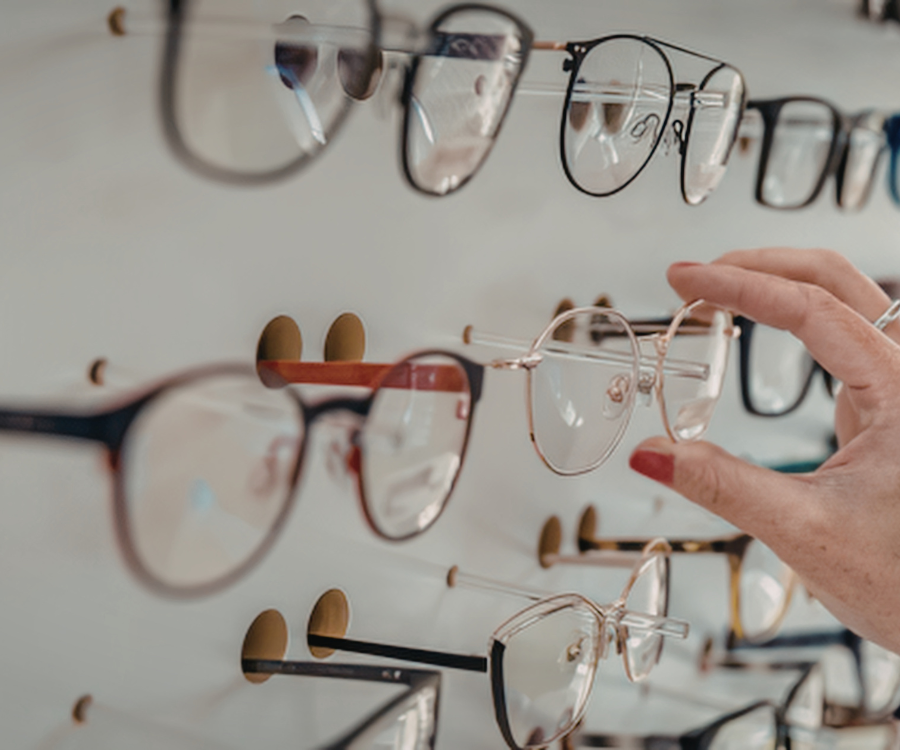
Let’s be honest: choosing new glasses can feel a bit like dating. You see a pair that looks stunning on the shelf (or the model), but once you try them on, the “spark” just isn’t there.
The secret to finding “the one” isn’t about following the latest trends—it’s about balance. Your frames should contrast your facial features to create a harmonious look. Whether you’re a sharp-jawed square or a soft-featured circle, here is your definitive guide to finding the perfect frames.
Step 1: Identify Your Face Shape
Before you start browsing, pull your hair back, look in the mirror, and trace the outline of your face. Most people fall into one of these five categories:
- Round: Soft curves, similar width and length, and a less defined jawline.
- Square: A strong, horizontal jawline and a broad forehead.
- Oval: Balanced proportions with slightly high cheekbones and a chin slightly narrower than the forehead.
- Heart: A wide forehead that tapers down to a narrow, pointed chin.
- Diamond: Narrow at the forehead and jawline, with wide, dramatic cheekbones.
Step 2: The Best Frames for Every Shape
1. Round Face Shape
The Goal: Add definition and lengthen the face.
Since round faces lack sharp angles, you want to introduce them. Look for rectangular or square frames that sit high on the temples. These provide contrast and make your face appear thinner and longer.
- Avoid: Small, round, or rimless frames that emphasize the circularity.
2. Square Face Shape
The Goal: Soften the angles.
If you have a strong jawline, you want to draw the eye upward and add some softness. Round or oval frames are your best friend here. Even Cat-eye frames work wonders by adding a feminine lift to sharp features.
- Avoid: Boxy, angular frames that make your face look overly “heavy.”
3. Oval Face Shape
The Goal: Maintain balance.
You’ve hit the genetic lottery for eyewear! Oval faces are naturally balanced, meaning you can pull off almost any style. The trick is to find frames that are as wide as (or slightly wider than) the broadest part of your face.
- Avoid: Frames that are so oversized they disrupt your natural symmetry.
4. Heart Face Shape
The Goal: Balance the forehead and chin.
Because the top of your face is wider, you want frames that add “weight” to the bottom. Bottom-heavy frames or Aviators work beautifully. Rimless or light-colored frames are also great because they don’t overwhelm the top half of your face.
- Avoid: Top-heavy styles or frames with heavy decorative temples.
5. Diamond Face Shape
The Goal: Highlight the eyes and soften cheekbones.
Diamond is the rarest face shape. To complement those killer cheekbones, try Cat-eye frames or top-heavy browline glasses. These styles draw attention to your eyes and brow line while softening the middle of the face.
- Avoid: Narrow, boxy frames that can make your cheekbones look even wider.
Quick Reference Comparison
| Face Shape | Key Strategy | Recommended Styles |
| Round | Add Angles | Rectangular, Square, Wayfarer |
| Square | Soften Lines | Round, Oval, Cat-eye |
| Oval | Keep Balance | Any style (especially wide frames) |
| Heart | Minimize Width | Aviators, Bottom-heavy, Rimless |
| Diamond | Accentuate Eyes | Browline, Cat-eye, Oval |
A Final Tip: Don’t Forget Skin Tone!
While shape is the foundation, color is the finish.
- Warm Tones: If you have gold or peach undertones, go for tortoise, honey, olive, or warm reds.
- Cool Tones: If you have blue or pink undertones, silver, black, dark tortoise, and “jewel” tones (like emerald or plum) will make your face pop.
Ready to Shop?
The most important rule? Confidence. If you love a pair of glasses that “technically” breaks these rules, wear them anyway. Your personality is the best accessory you own.