
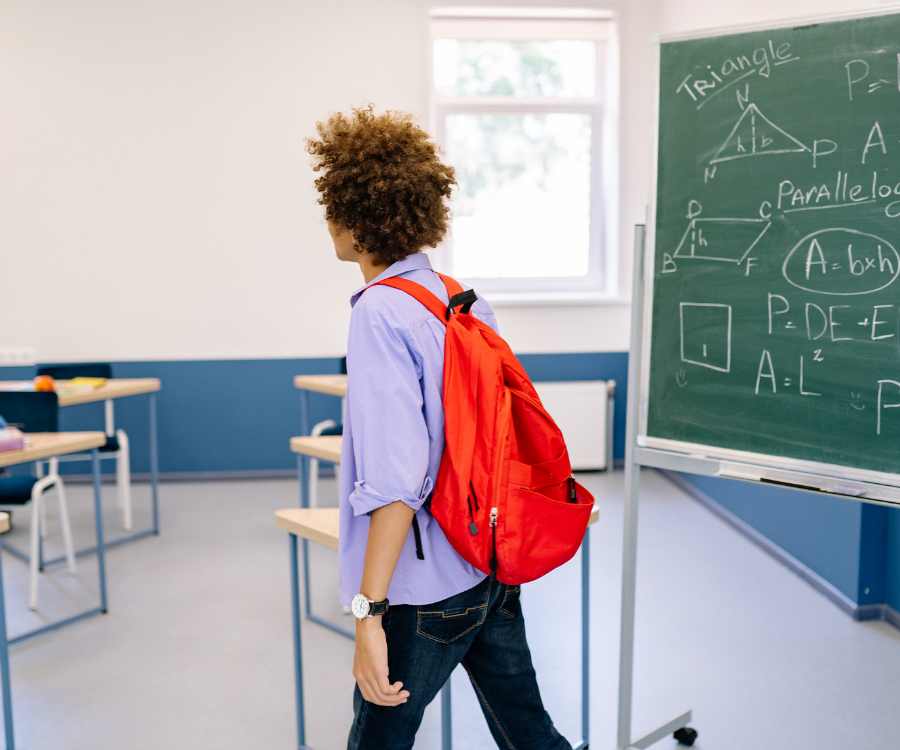
Children rarely complain that their vision is blurry simply because they assume everyone sees the world the exact same way they do. When a child has difficulty reading the classroom board, it often shows up first as behavioral friction, fatigue, or sliding grades rather than an outright request for glasses.
Roughly 80% of classroom learning is visual. Catching subtle vision issues early protects academic performance and prevents long-term eye strain.
Here are five telltale signs your child might be struggling to see the board clearly, along with what steps to take next.
1. Frequent Squinting, Tilting, or Closing One Eye
Squinting isn’t just a habit; it’s an instinctive physical trick. Narrowing the eyelids limits the amount of scattered light entering the eye and temporarily sharpens blurry distant objects (known as the pinhole effect).
Similarly, if your child tilts their head awkwardly or covers one eye when trying to focus on something across the room, they may be trying to compensate for an astigmatism or a binocular vision issue where one eye focuses better than the other.
2. Unexplained Headaches or Eye Rubbing After School
Focusing hard to decipher distant text forces the ciliary muscles in the eyes into constant tension.
If your child routinely comes home from school complaining of:
- Dull frontal headaches around the forehead or temples
- Sore, watery, or itchy eyes
- Excessive eye rubbing during or after homework
It’s often a reaction to hours spent straining to resolve distant board work and shifting focus back down to their desk.
3. Slipping Grades, Slower Copying, and Incomplete Notes
When teachers present new concepts, they typically alternate between verbal explanations and board demonstrations. A child who cannot see the board clearly faces immediate setbacks:
- Incomplete notebook entries: They cannot keep up with board copying and give up midway.
- Over-reliance on desk neighbors: Looking over a peer’s shoulder to copy notes, which teachers frequently mistake for chatting or lack of focus.
- Sudden dips in reading comprehension or math: Missing crucial negative signs, decimal points, or punctuation markers written on the whiteboard.
4. Frustration, Restlessness, or “Daydreaming” in Class
Undiagnosed refractive errors like myopia (nearsightedness) often mimic attention difficulties. When a board looks like an illegible blur for 45 minutes, a child’s attention naturally drifts elsewhere.
Teachers may report that the child is easily distracted, fidgety, or disengaged during large-group instruction. Before jumping to behavioral conclusions, ruling out visual obstacles should always be step one.
5. Sitting Too Close to Screens or Holding Books Abnormally Close
Vision issues don’t stop at the classroom door. Observe how your child interacts with screens and reading materials at home:
- Moving within inches of the television screen
- Bringing tablets or phones right up to the bridge of their nose
- Leaning their entire chest onto the desk while writing
While occasional close viewing can be normal for young toddlers, school-aged children doing this consistently are often demonstrating a reduced visual focal range.
Vision Screenings vs. Comprehensive Eye Exams
Many parents rely on annual school vision screenings, assuming a “pass” guarantees clear sight. However, standard school screenings primarily test distance acuity (the traditional Snellen 20/20 eye chart) and miss up to 75% of vision problems, including eye coordination, depth perception, and subtle astigmatism.
| Feature | School Vision Screening | Comprehensive Eye Exam |
| Administered By | School nurse or volunteer | Optometrist or Ophthalmologist |
| Scope | Basic distance acuity check | Full health & functional visual assessment |
| Evaluates | Distance sharpness only | Refraction, binocular alignment, retina health, focusing speed |
| Outcome | Pass/Fail referral | Prescription diagnosis & customized treatment |
What to Do If You Notice These Signs
- Talk to their teacher: Ask if they notice your child leaning forward, squinting, or asking to move closer to the front row.
- Schedule an appointment with an optometrist: A pediatric or general comprehensive eye examination takes 30 to 45 minutes and provides a definitive diagnosis.
- Request a temporary seat adjustment: While waiting for an exam or prescription lenses, ask the school to seat your child in the center-front row so they don’t fall behind on lessons.
Addressing vision changes early not only boosts classroom confidence—it ensures your child has the clarity they need to thrive.