
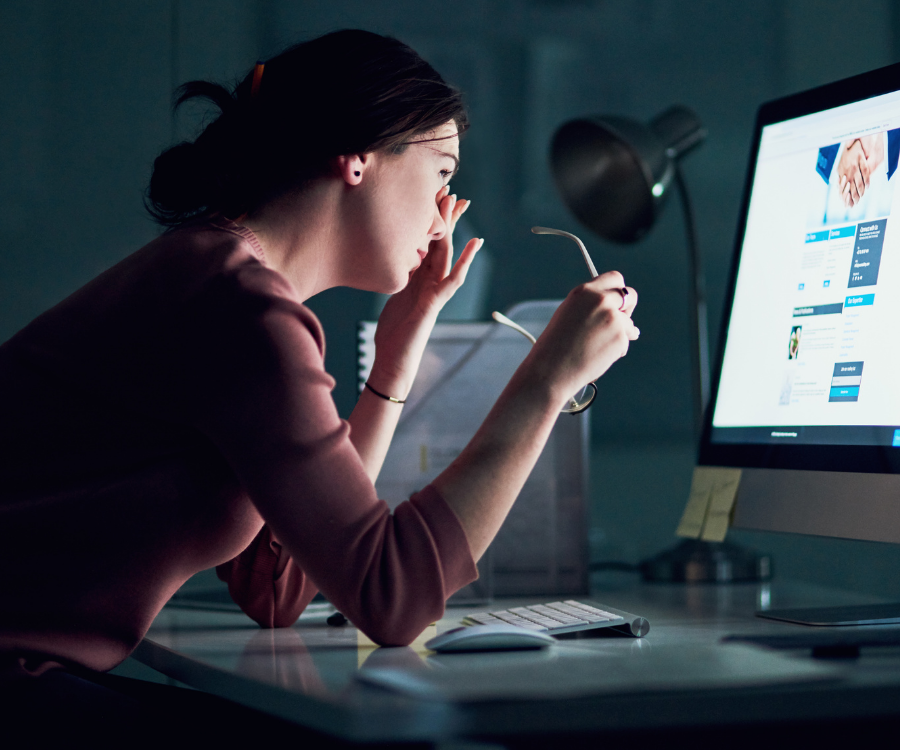
If you spend your workday jumping between monitors, laptops, and smartphones, that familiar dull ache behind your eyebrows or gritty, burning sensation in your eyes needs no introduction.
For years, alarming headlines have warned that digital displays are silently destroying our retinas. But as display technology evolves—with higher pixel densities, OLED advancements, and adaptive color systems—what does the peer-reviewed clinical science actually prove?
Here is the direct answer: No, screens do not cause permanent structural damage or blindness in healthy adult eyes. However, they cause significant functional fatigue, evaporative dry eye, and developmental risks in children.
Understanding the distinction between temporary ocular fatigue and permanent damage is essential for protecting your vision long-term.
The Real Culprit: Computer Vision Syndrome (CVS)
When your eyes burn after a ten-hour workday, you are experiencing Computer Vision Syndrome (CVS), widely recognized as Digital Eye Strain (DES).
CVS is not a degenerative disease; it is an overuse and biomechanical issue stemming from how the human visual system interacts with pixels. Two primary mechanisms drive this discomfort:
1. The Blink Rate Collapse
Under normal conditions, humans blink approximately 15 to 20 times per minute. This steady blinking redistributes the tear film—a delicate mix of water, lipids, and mucin that protects and lubricates the cornea.
Studies show that intense visual focus on digital displays reduces blink frequency by 50% to 66%, and many of those blinks are incomplete. Without complete, regular blinks, your tear film evaporates, leaving exposed nerve endings on the corneal surface that trigger dryness, redness, and foreign-body sensations.
2. Ciliary Muscle Spasm (Accommodative Lock)
Looking into the distance relaxes the eye’s internal focusing engine. Holding focus on an object 40 to 60 cm away forces your ciliary muscles to remain continuously contracted to bend the crystalline lens. Keeping any muscle contracted for hours without relief causes fatigue and temporary spasms, leading to transient distance blur when you finally look up from your desk.
The Blue Light Debate: Marketing vs. Clinical Reality
Blue-blocking coatings and amber tinted glasses have dominated consumer optics, marketed as essential shields against macular degeneration. Clinical evaluations, however, clarify what blue light does—and does not—do:
- Retinal Toxicity: The blue-wavelength emissions produced by commercial laptops, tablets, and phones are orders of magnitude lower than natural outdoor daylight. Extensive ophthalmological consensus confirms that digital blue light levels do not induce photochemical retinal burns or macular decay.
- Visual Fatigue: Systematic clinical trials continue to show that blue-light filtering lenses offer minimal to no measurable improvement in relieving the daytime physical symptoms of digital eye strain compared to standard clear lenses.
- The Circadian Factor: Where blue light does exert a proven biological impact is on sleep architecture. Blue wavelengths suppress melatonin secretion via intrinsically photosensitive retinal ganglion cells (ipRGCs). Late-night screen exposure disrupts your natural sleep-wake cycle, preventing restorative rest and exacerbating eye irritation the following morning.
The One Legitimate Long-Term Risk: Pediatric Myopia
While screen time does not permanently damage adult eyes, the story differs significantly for children and adolescents.
The human eye continues to grow into the early twenties. Decades of epidemiological data reveal a strong correlation between excessive, uninterrupted near work (holding books or tablets closer than 30 cm) and the acceleration of axial elongation of the eyeball—the physical mechanism behind myopia (nearsightedness).
The primary protective countermeasure identified by researchers is not special glasses, but natural outdoor daylight, which stimulates retinal dopamine release and regulates healthy eye elongation.
| Factor | Adult Eyes | Pediatric Eyes (Under 18) |
| Primary Risk | Evaporative dry eye & visual fatigue | Axial myopia progression (nearsightedness) |
| Permanent Damage? | No; symptoms reverse with behavioral changes | Potential permanent refractive change |
| Core Trigger | Decreased blinking & prolonged focal distance | Intense near-work combined with limited outdoor light |
| Best Solution | Ergonomics & lubricating breaks | Daily outdoor daylight exposure (90+ minutes) & near-work limits |
Evidence-Based Solutions That Actually Work
Relieving screen fatigue requires addressing friction points in blink rate, lighting, and focal depth.
- Automate the 20-20-20 Rule: Every 20 minutes, pause and shift your gaze to an object at least 20 feet (6 meters) away for a minimum of 20 seconds. This releases the ciliary muscle’s accommodative lock and allows your focusing system to reset.
- Position Displays 15° to 20° Below Eye Level: When you look slightly downward, your eyelids cover more surface area of the ocular globe, substantially reducing the exposed tear evaporation zone compared to looking straight ahead.
- Match Screen Brightness to Ambient Lighting: A glaring display in a dim room forces pupillary oscillation and heightens contrast fatigue. Adjust your monitor’s luminance to match your surrounding office light, and angle the screen away from direct window glare.
- Keep Preservative-Free Lubricating Drops at Your Desk: If your working environment has air conditioning or forced airflow, artificial tears with carboxymethylcellulose or hyaluronic acid replenish the tear film during heavy spreadsheet or coding sessions.
- Update Your Prescription for Computer Working Distances: General reading glasses are calibrated for 35–40 cm, while distant lenses focus at infinity. If you work on multiple monitors placed 60–80 cm away, an intermediate prescription or specialized computer progressive lens removes chronic accommodative strain.
Your screens are not blinding you, but they are taxing your ocular mechanics. Treating screen fatigue as an ergonomic and tear-film management problem—rather than fearing light toxicity—is the most effective way to keep your eyes comfortable and healthy.